
Writing ·
The Essence Of Relationality: Yoneda Lemma And The Jeweled Net Of Indra
Table of Contents:
Science Mathematics and Philosophy
The Necessity of the Subjective Witness
The Yoneda Lemma: Objects as Relations
The Yoneda Lemma says something simple to state and hard to take in: the essence of a mathematical object is not in the object. It is in its relationships with other objects. The lemma sits near the center of Category Theory, and in formal terms it says that an object in a category is fully determined by the morphisms, the arrows, it has with other objects. I want to consider it here as a foundation for what gets called the "mathematics of mathematics," a rigorous way of understanding mathematical structures by nothing but their relationships. If you want to go deeper into the Yoneda Lemma and Category Theory than I will here, nLab and the Stanford Encyclopedia of Philosophy are where I would send you.
The Jeweled Net of Indra: Existence as Reflection of Empty Infinity
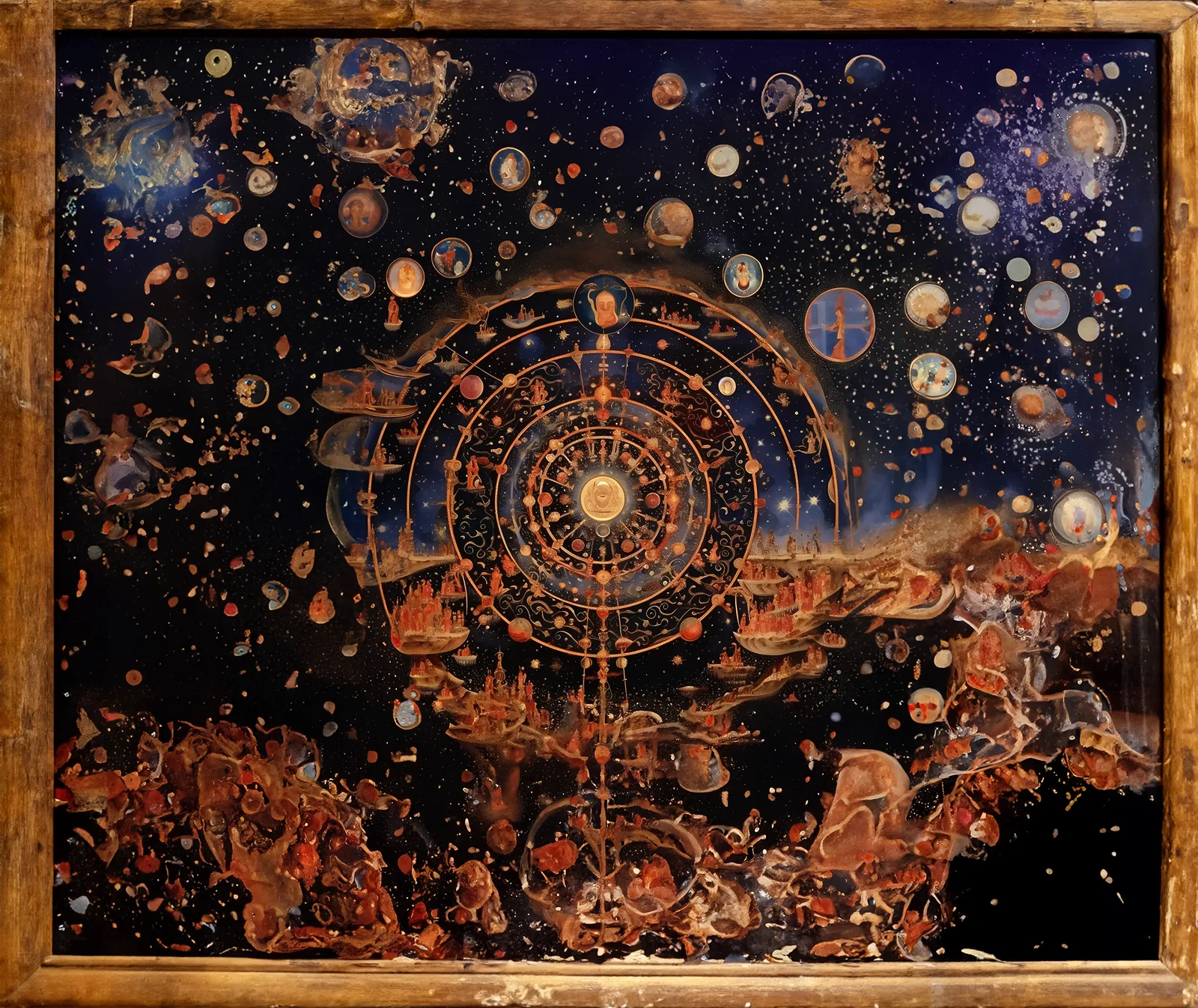
The Jeweled Net of Indra comes from Mahayana Buddhism. Picture an infinite net with a jewel at every knot, and every jewel reflecting every other jewel. The essence of any one jewel is not its individuality. It is the particular configuration of reflections it holds of all the rest. The image turns up in a number of sutras, including the Vimalakirti Sutra, which also offers the Parasol of the Goddess as a figure for the same interconnectedness. For me the Jeweled Net is the strongest metaphor there is for Sunyata, the emptiness of nature: every dharma is empty of inherent existence.
The net says something more, too. Each point of consciousness is the universe experiencing itself from that one vantage point. The "Now" moment for each of us is a unique configuration in the net, reflecting all the others and reflected by them. In this sense each subjective experience of consciousness is the universe itself, experiencing from a unique "Now."
Yoneda Lemma and Subjective Experience
To understand the Yoneda Lemma you have to let your perception shift. Mathematical objects stop being static things and become nodes in a moving network of relationships.
I find the same shift in subjective experience, where each moment can be seen as a unique configuration of sensory inputs, thoughts, and emotions. The three-world model gives me a way to hold this: the Subjective, the Corporeal, and the Objective worlds. The Subjective world is the realm of individual experience. The Corporeal world is the realm of entities we meet through the senses. The Objective world holds the models we make of the Corporeal world.
Interconnectedness of Consciousness
The Jeweled Net of Indra gives me a way to think about how every point of consciousness touches every other. Each person's experience of "Now" is a unique reflection of the whole universe. This sits well with certain interpretations of quantum mechanics, and with some theories of consciousness, which suggest that each point of observation is its own intersection of Now, uniquely complete in its actualization.
Convergence in Understanding
Both the Yoneda Lemma and the Jeweled Net say that the essence of an object, or of an experience, is its unique set of relationships with everything else. Both say the whole is reflected in each part. The Yoneda Lemma shows an object to be a set of relationships within the whole category. The Jeweled Net says each person's moment of "Now" is the universe experiencing itself.
The two come from fields that could hardly be further apart, and they converge on one idea: the essence of an object or an experience is relational all the way down. The Yoneda Lemma gives this a formal shape in the realm of mathematical objects. The Jeweled Net of Indra gives it a more poetic shape, and to my mind an equally deep one, in the realm of existence and consciousness. I use both as tools for thinking about the individual and the universal, the part and the whole, and the way each holds the other.
The Philosophical Scope of the Jeweled Net
The Jeweled Net of Indra comes out of Buddhist texts, but what it does belongs to philosophy rather than religion. Buddhism is agnostic on the question of God, and the Buddha is considered a human who attained enlightenment. So I treat the Jeweled Net as a philosophical tool, a way of understanding interconnectedness and contextuality, and the story of existence is richer for it.
Phenomenology: The Science of Sciences
Phenomenology is what lets me bring Buddhist philosophy and Category Theory into one scientific frame. I call it the "science of sciences" because it gives the others their foundation by recognizing the distinctions between three worlds: the Physical (Corporeal) world of measurements, the Subjective world of conscious experience, and the Objective World of shared language forms, inscribed in or interpreted from the Physical world as it is lived (the Corporeal, the Lifeworld).
The Necessity of the Subjective Witness
I prefer the word "witness" to "observer" for the subjective one who is present in experience. It fits with the Catuskoti, the fourfold negation in Buddhist logic that undoes binary oppositions and the fixed nature of meaning. The witness goes through three phases: experiencing, learning lessons, and reacting. Each phase can be looked at through the Catuskoti, and the picture of subjective experience that comes back is finer than any either/or.
When I work through these frameworks and the places where they cross, I come away with tools for thinking about the individual and the universal, and both the scientific and the philosophical stories grow by it.
Yoneda Lemma in the Context of Category Theory: A Mathematics of Mathematics
The Yoneda Lemma is a foundational result in category theory, the branch of mathematics that gives a single frame to many different mathematical structures and concepts. Category theory abstracts mathematical objects, and the morphisms between them, into categories, and so gives a language for talking about mathematical structures in a general way. The lemma, named for Nobuo Yoneda, makes formal the idea that an object in a category is determined by its relationships with other objects.
The Lemma states that for any category C and any object A in C, the set of morphisms from A to any object B in C uniquely determines A. In plain words: you are what your relationships to other objects say you are. The consequences run well beyond pure mathematics, into computer science, logic, and philosophy, where the lemma can be read as a formalization of contextuality and relationality.
The Yoneda Lemma is a "mathematics of mathematics" in that it gives a meta-level understanding of mathematical structures. With it, mathematicians can understand categories, and so a great many mathematical theories, from the inside, by how the objects within those categories relate to each other.
For further reading:
The Jeweled Net of Indra and Sunyata: A Tapestry of Interconnectedness and Emptiness
The idea of Indra's Net begins in the ancient Indian text, the Atharva Veda, and was taken up and elaborated in various Mahayana Buddhist sutras. It is cited again and again as a metaphor for the interconnectedness and interdependence of all things. The net is a vast cosmic lattice with a jewel at each vertex, and each jewel reflects all the other jewels in the net. This is a figure for "emptiness" (Sunyata), the teaching that all phenomena (dharmas) are empty of inherent nature and exist only in relation to other phenomena.
The Parasol of the Goddess, from the Vimalakirti Sutra, is a second metaphor that sits well beside the Jeweled Net. The parasol stands for protection and sovereignty, and it is often used to represent the encompassing sky, under which all dualities and distinctions collapse. That fits with Sunyata: all dharmas are empty of nature, without independent existence.
For further reading:
Both the Yoneda Lemma and the Jeweled Net of Indra are tools for understanding relation in their own domains, mathematics and philosophy. Each gives a way of understanding things by their relationships rather than as isolated objects, and the story of interconnectedness and contextuality is the richer for it.
The Yoneda Lemma and the Jeweled Net of Indra: Relational Frameworks in Mathematics and Philosophy
Introduction
The Yoneda Lemma and the Jeweled Net of Indra look like strangers to each other, one from mathematics and one from Eastern philosophy. Yet both are deep tools for understanding relation in their own domains. I want to go further into each of them here, and into what each does for the story of interconnectedness and contextuality.
The Yoneda Lemma: A Mathematical Framework for Relationality
As I said above, the Yoneda Lemma in category theory holds that an object is fully determined by its relationships with other objects. The consequences reach past pure mathematics into computer science, logic, and philosophy. It is a "mathematics of mathematics," a meta-level understanding of mathematical structures built on relationality.
The Jeweled Net of Indra: A Philosophical, Not Religious, Framework
The Jeweled Net of Indra, which most people meet through Mahayana Buddhism, is a metaphor for the interconnectedness and interdependence of all phenomena. Each jewel in the net reflects all the other jewels; nothing is isolated, and everything exists in a web of relationships. The idea is rooted in Buddhist texts, but its scope is philosophical rather than religious.
Buddhism, in its Mahayana form especially, is agnostic about the concept of God. It does speak of gods and goddesses, but these are beings within the Buddhafields, or the multiverse, not supreme beings. The Buddha is a human who attained enlightenment, free from delusion. That attention to human potential and to the nature of existence is closer to philosophy's search for understanding than to religion's concern with divinity.
Interconnectedness: The Common Thread
Both the Yoneda Lemma and the Jeweled Net of Indra say that the essence of a thing, whether a mathematical object or a point of consciousness, is defined by its relationships. That shared attention to interconnectedness is one lens through which two unrelated fields can be seen at once.
The Universal in the Individual
Both frameworks say the whole is reflected in each part. In the Yoneda Lemma, an object is a unique set of relationships within the whole category. In the Jeweled Net, each person's moment of "Now" is the universe experiencing itself. This fits with certain interpretations of quantum mechanics and with some theories of consciousness, and it points to a complicated relation between the individual and the universal, between the part and the whole.
Conclusion
The Yoneda Lemma and the Jeweled Net of Indra start in different fields and arrive at the same idea: the essence of a thing or an experience is relational. The lemma gives a formal way to understand this for mathematical objects. The net gives a more poetic, and equally deep, way to understand it for existence and consciousness. Both are tools I use for thinking about the individual and the universal, and they make the story of interconnectedness and contextuality richer.
Phenomenology, Category Theory, and Buddhist Philosophy: Bridging the Domains of Science, Mathematics, and Philosophy
Phenomenology, Category Theory, and Buddhist Philosophy are three fields that seem to have nothing to do with each other. Looked at through relationality and interconnectedness, though, they offer one frame for understanding the nature of existence, consciousness, and mathematical objects. I want to draw out these connections here, building on what I have written before about phenomenology and the "Three Worlds of Being," the Corporeal, the Subjective, and the Objective.
Phenomenology: The Science of Sciences
Phenomenology, usually credited to Edmund Husserl, is the foundation from which the first principles of the various sciences can be understood. It gives a systematic way of synthesizing and integrating observations and predictions across phenomena. It gets called the "Science of Sciences" because it understands the scientific disciplines from a level above them. It is the bridge between the subjective world of conscious experience and the objective world of scientific inquiry.
Category Theory: The Mathematics of Mathematics
Category Theory, with the Yoneda Lemma among its key ideas, is a "mathematics of mathematics," a meta-level understanding of mathematical structures. The Yoneda Lemma holds that a mathematical object is fully determined by its relationships with other objects, which puts relationality at the center of how mathematical structures are understood.
Buddhist Philosophy: Beyond Religion to Philosophy
Buddhist Philosophy, and the Jeweled Net of Indra in particular, gives a frame for understanding the interconnectedness and interdependence of all phenomena. These ideas are usually met in religious settings, but their essence is philosophical. Buddhism is agnostic about the concept of God. Its concern is human potential and the nature of existence, which is philosophy's concern too.
The Three Worlds of Being
The Corporeal world is the physical, tangible world that can be measured and observed. The Subjective world is the internal, mental world of thoughts, emotions, and experiences. The Objective world is the world of shared knowledge, language, and cultural constructs. The three worlds act on each other, and between them they shape what we take reality to be. Language and writing do a great deal of the shaping of the Objective world, and sometimes they get in the way of direct experience of the Corporeal and Subjective worlds.
Convergence in Understanding
- Essence in Relation: Phenomenology, Category Theory, and Buddhist Philosophy all hold that the essence of an object or an experience is in its unique set of relationships with everything else.
- Universe in the Individual: All three say the whole is reflected in each part. Phenomenology gives a method for exploring this, Category Theory gives a mathematical formalism, and Buddhist Philosophy gives a more poetic but equally deep understanding.
- Subjective Experience as Universal: In all three, subjective experience is the point where the individual and the universal meet. Phenomenology offers a rigorous method for exploring that meeting, Category Theory offers the mathematical tools, and Buddhist Philosophy offers the conceptual frame.
Phenomenology, Category Theory, and Buddhist Philosophy start in different fields and converge on one idea: the essence of a thing or an experience is relational. They are tools for understanding the relation between the individual and the universal, and they make the story of interconnectedness and contextuality richer. Through them I can see a little better how our understanding of reality is woven, from mathematical objects to conscious experience.
The Necessity of the Subjective Witness: A Journey Through Experience, Lessons, and Reaction
The "subjective observer" has been argued over for a long time in both scientific and philosophical circles. I think the word "witness" catches the role better, especially once Buddhist philosophy and the Catuskoti are in the picture. What follows takes the witness through three phases, experiencing, learning lessons, and reacting, and asks how each phase looks through the Catuskoti, the fourfold negation in Buddhist logic.
The Witness: Beyond the Observer
"Observer" suggests someone standing apart, recording events without taking part in them. A "witness" is more than that. The witness is inside the experience, both the one who experiences and the one who gives testimony to it, and that doubling adds reflexivity. Without reflexivity I do not think the depth and complexity of subjective experience can be understood at all.
Catuskoti: Challenging Fixed Meanings
The Catuskoti is the fourfold negation used in Buddhist logic to challenge binary oppositions and the fixed nature of meaning. It is also called the Tetralemma, and it holds four logical possibilities open: something is, is not, both is and is not, or neither is nor is not. Where binary logic has two boxes, this has four, and a way out of all of them. It is a useful tool for looking at the witness's experience.
Phase One: Experiencing
In the first phase the witness is wholly in the experience. Whether it is a sensory perception, an emotional state, or a cognitive process, the witness is the place where these phenomena show up. Through the Catuskoti, the experience is not a simple binary of happening or not happening. It can sit in ambiguity, present in some respects and absent in others, and what it means to "experience" gets wider for that.
Phase Two: Learning Lessons
The second phase is drawing lessons from the experience. These lessons are not data points. They are understandings that get taken in and go on to shape experiences and reactions still to come. The Catuskoti again gives a finer view. A lesson learned is not a fixed piece of wisdom but a living understanding that can be both true and not true depending on the context.
Phase Three: Reacting
The third phase is the reaction, where the witness responds to the experience and to the lessons taken from it. This is not a mechanical response. Past experiences, present context, and what may follow all enter into it. The Catuskoti lets the reaction be understood from more than one side: it can be both appropriate and inappropriate, both meaningful and meaningless, depending on many things.
The witness, looked at through the Catuskoti, gives a rich frame for understanding subjective experience. It admits the complexity in each phase of the process: experiencing, learning lessons, and reacting. By stepping past binary logic and fixed meanings, we come to a fuller understanding of what it means to be a witness to our own lives, and both the scientific and the philosophical stories are richer for it.
First published on temnoon.com. Re-voiced from that original, in the Tem Noon Voice persona (9497f2d0) on 2026-10-11; the original is kept in the archive.