Writing ·
What Is Phenomenology?
Crisis of Modern Science - A Husserl Redux
This paper explores an integrated framework to address the crisis of the sciences, as identified by Edmund Husserl in "The Crisis of European Sciences and Transcendental Phenomenology." Drawing on insights from phenomenology, George Spencer-Brown's Laws of Form, Jacques Derrida's deconstruction, and Nagarjuna's Catuskoti, the framework aims to provide a comprehensive and nuanced understanding of the relationship between subjective experience, mathematical structures, language, and the objective world. The paper examines Husserl's phenomenological project, the relevance of the Laws of Form to the crisis of the sciences, the inherent uncertainty of language posed by deconstruction, and the complexities of subjective experience through the lens of Catuskoti. The integrated framework, incorporating the underlying Dharma of the moment and Sunyata, addresses the crisis of the sciences by fostering interdisciplinary collaboration and dialogue, addressing epistemological challenges, and promoting a more open, flexible, and comprehensive approach to knowledge-seeking endeavors. The paper concludes by emphasizing the potential benefits and insights offered by the framework for the future of scientific inquiry and calls for further exploration and development of this integrated approach.
→ /the-crisis-of-modern-science-and-the-origin-of-the-objective-world/
Below is the text I am writing above, perhaps going a little farther on then shown in the 12 minutes of video. But the video is a useful example of an unusually phenomenological view of writing itself.
Phenolenology is responsible for exploring the necessary structures of our consciousness, so that we can account if not eliminate the limits and biases those structures may have on the models we make of the world.
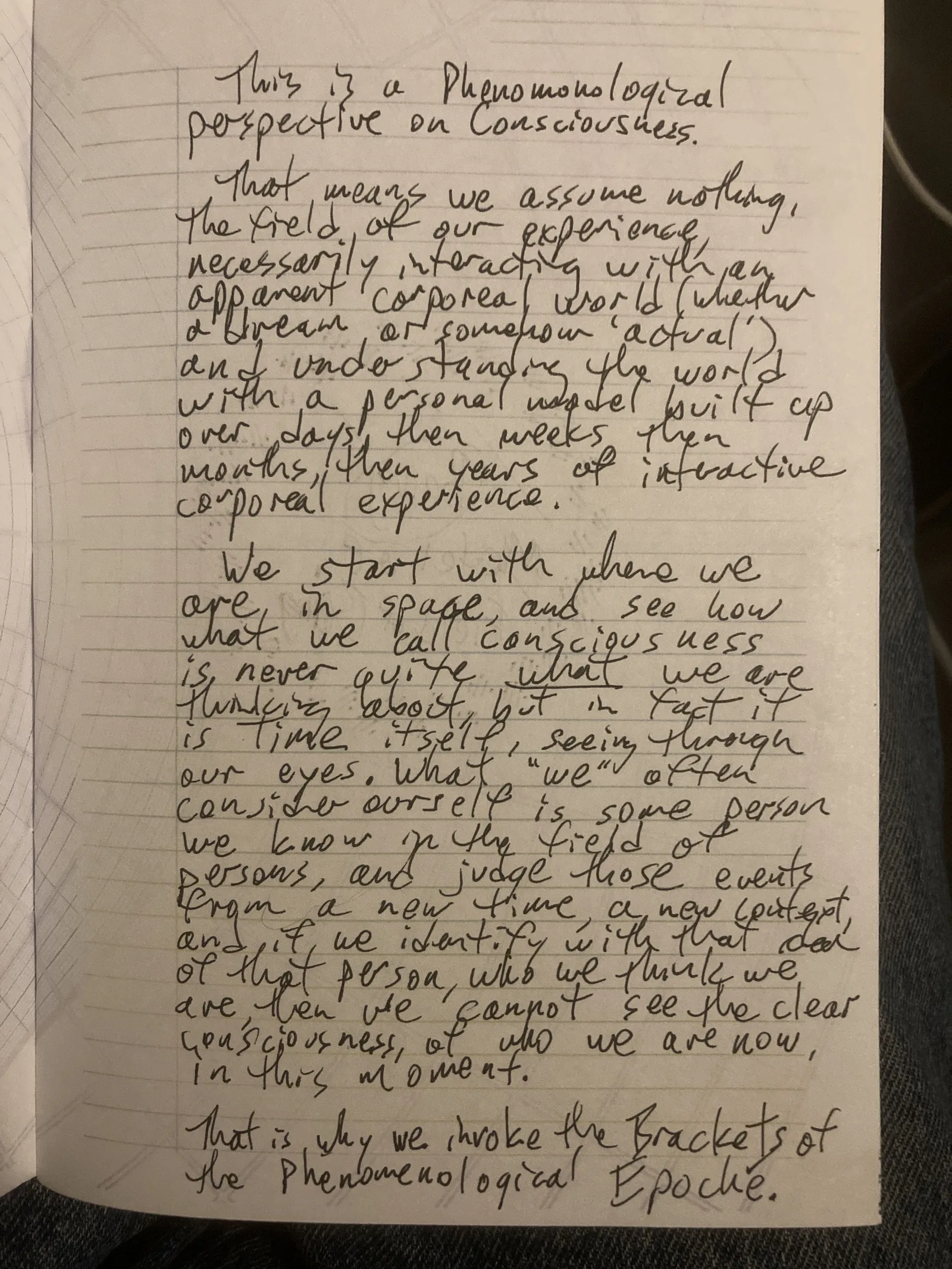
This is a Phenomenalogical Perspective on Consciousness
That means we assume nothing, the field of our experience, necessarily interacting with an apparent corporeal world (Whether in a dream or somehow 'actual') and understanding the world with a personal model built up over days, then weeks, eventually years and years of interactive corporeal experience.
We start with where we are in space and see how what we call consciousness is never quite What we are thinking about, but in fact it is Time itself, seeing through our eyes. What "we" often consider ourself is some person we know in the field of persons, and judge those events from a new time, a new context, and, if we identify with that idea of that person, who we thinki we are then we cannot see the clear consciousness of who we are now in this moment.
That is why we invoke the Brackets of the Phenomenological Epoké.
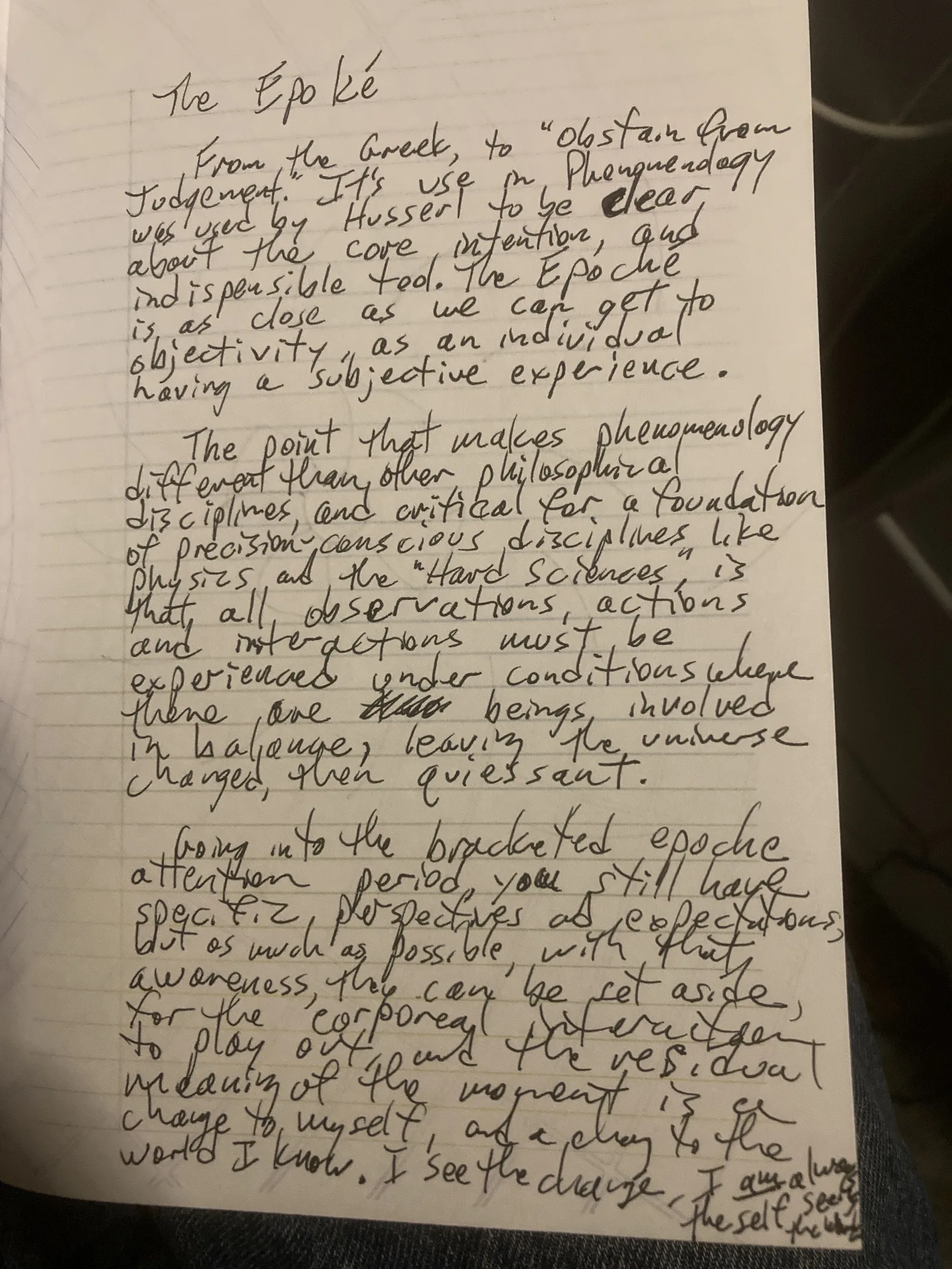
The Epoké
From the Greek for "Abstain from Judgement". Its use in Phenomenology by Husserl was to be clear about the core intention. This is an indispensable tool. The Epoké is as close as we can get to objectivity, as an individual having a subjective experience. Any and all experiences are subjective experiences.
The point that makes phenomenology different than other philosophical disciplines and critical for a foundation of precision-conscious disciplines like physics and the "hard sciences", is that all observations must be experienced under conditions where there are beings involved in balance, interacting with a universe in some way charged or unbalanced, and balancing it to a relative quiescence.
Going into the bracketed epoké attention period, you still have specific perspectived and expectations, but as much as possible, with that awareness, they can be set aside, for the corporeal interaction to play out and the residual meaning of the moment is a change to myself and a change to the world I know. I see the change, I am always the self seeing the world.
Afterword
Reading it now, and typing it in (changing some things to help it make some sense) I don't think this answers the question. I know what I was trying to say, but I don't have much confidence that many people will read it through.
It may be possible to watch the video again, and see where in my hand movements I got lost, and where I could have taken a different verbal turn.
First published on temnoon.com.