
Writing ·
Heart Sutra Science: Definition, Origins, And Purpose
Heart Sutra Science: Definition, Origins, and Purpose
Heart Sutra Science (HSS) is my name for a way of thinking that joins the Heart Sutra with phenomenology and modern science. The sutra is the ancient Eastern wisdom I start from; phenomenology and the sciences are the modern understanding I bring to it. What HSS tries to do is understand existence by looking at how consciousness, reality, and interconnectedness bear on one another. To be clear, the purpose is not to translate the Heart Sutra into scientific terms. It is to use the sutra as a foundation for a full, and necessarily personal, exploration of the nature of being, of consciousness, and of the universe.
HSS began when I recognized a deep resonance between the teachings of the Heart Sutra and the principles of phenomenology, and then with a number of scientific disciplines as well. What the Heart Sutra teaches about the emptiness and interdependence of all phenomena lines up with the interconnectedness that quantum physics, ecology, and cognitive science keep finding. Phenomenology, with its attention to the structures of consciousness, gives a way to think about the subjective nature of reality. The meeting of the old wisdom and the new science is what moved me to build this framework, and what I want from it is one vocabulary for exploring the fundamental nature of existence.
The Heart Sutra: An Overview and Its Relevance to Science
The Heart Sutra, the Prajnaparamita Hridaya, is a short text that holds the essence of Mahayana Buddhism’s wisdom. It teaches śūnyatā, emptiness: all phenomena are without inherent existence and arise in dependence on one another. That cuts against our ordinary understanding of reality, and asks us to see things as whole and interconnected instead.
Why does this matter to science? Because the sutra offers fresh ways of looking at questions science has carried for a long time. Its teaching on emptiness and interdependence resonates with quantum mechanics, where particles exist as potentiality and are shaped by their relationships with other particles. And its emphasis on the part perception plays in shaping our experience of reality echoes what cognitive science and psychology have found.
The Interdisciplinary Nature of Heart Sutra Science
Heart Sutra Science cannot belong to one discipline. It draws on philosophy, physics, biology, psychology, and the social sciences, and tries to bring those perspectives into one frame that can hold hard questions about the nature of existence, consciousness, and reality.
In HSS I do not treat each discipline as its own silo of knowledge. Each is a piece of a larger puzzle. What each field finds gets woven in with the rest, and each throws light on a different face of the same underlying reality. Working this way, HSS can take up questions that no single discipline can reach on its own, and I hope come to a fuller understanding of our world.
Part II: Theoretical Foundations
Husserl’s Epoché and the Being in a Field of Being Model
Edmund Husserl, who founded phenomenology, introduced the Epoché: a method of bracketing, of suspending judgment about the natural world so that attention can go to experience itself. The method opens a more direct investigation of consciousness and of the structures of experience.
In Heart Sutra Science this idea takes the shape of the Being in a Field of Being model. Each Being is immersed in a field of other Beings, and interacts with that field at each tick of the shortest clock that level of Being experiences. It is as much a model of the self as it is a model of the Universe, since each has models of the other.
Being in a Field of Being
The Being in a Field of Being model is a model of existence in motion. Each Being is always interacting with its environment, its field of Being, in a three-phase process that happens within the fuzzy boundary of the Being’s form, its body.
- Interaction: In the first phase the Being interacts with the field of Being. This happens in the frequencies the Being’s senses are in resonance with. It is perception: the Being takes in information from its surroundings.
- Effect: In the second phase the Being works on that information inside itself. It recalls what the perceived changes mean, going by its past experiences and what it knows. This is the phase of reflection and interpretation.
- Reaction: In the last phase the Being reacts back into the field. The reaction follows from how the perceived changes were interpreted. Afterward the Being returns to quiescence, ready for the next interaction.
The model implies a conservation of time, where each moment for a Being is defined by the completion of these three phases. It also carries the essence of śūnyatā, emptiness: all phenomena are defined by their interdependence and their constant change. In the Being in a Field of Being model, a Being is defined not by some inherent essence but by its ongoing interactions with its field of Being.
Part III: Phenomenological and Buddhist Convergences
The Convergence of Phenomenology and Buddhism
Phenomenology and Buddhism both set out to find the essence of experience and reality by peeling back the layers of perception and assumption. Each gives a method for understanding the nature of consciousness and existence through direct experience and deep reflection. What follows looks at the ground they share, and at how that ground supports Heart Sutra Science.
Phenomenological Methods
Phenomenology, in Husserl’s approach especially, means setting aside what you already think, and the biases you carry, so that you can examine the structures of consciousness. This bracketing, the Epoché, allows a pure, unmediated experience of phenomena, and from that a deeper understanding of their true nature.
Buddhist Methods
In Buddhism, mindfulness and meditation work toward a direct, present-moment awareness. By watching thoughts and sensations without attachment, the practitioner comes to perceive the transient, interconnected nature of all phenomena, which is what śūnyatā names.
Complementary Insights
Phenomenology and Buddhism meet on several key points:
- Non-duality of Subject and Object: Both hold that the separation between the observer and the observed is a made thing. In direct experience the boundary between self and other dissolves, and the interconnectedness of all things shows through.
- Impermanence and Emptiness: Phenomenology’s attention to the fluidity of experience fits the Buddhist understanding of impermanence and emptiness. All phenomena are transient and interdependent, with no inherent, unchanging essence.
Part IV: Ontology, Epistemology, and Insights from Cognitive Sciences
Ontology and Epistemology in Heart Sutra Science
Ontology, the study of being, and epistemology, the study of knowledge, are the foundations of Heart Sutra Science (HSS). HSS asks about the nature of existence and about the processes by which we come to know and understand our world. Both questions are informed by modern cognitive science, in particular work from the Massachusetts Institute of Technology (MIT) Department of Brain and Cognitive Sciences.
Ontology: The Nature of Being
In HSS, ontology is concerned with the nature of existence as it is experienced, in the meeting of consciousness and reality. This experiential view fits with the understanding that our sense of being is rooted in our embodied experience. Recent cognitive science gives strong evidence that our sense of self and of spatial awareness is localized in specific regions of the brain.
The posterior parietal cortex and the premotor cortex, for example, are key areas for integrating sensory and motor information into a coherent sense of spatial presence and agency. This embodied sense of being is what we know directly, with no need for language to mediate it. It is the pre-linguistic foundation of our existence, and it grounds our interactions with the world.
Epistemology: The Nature of Knowledge
Epistemology in HSS asks how we come to know and understand the world. That means looking at the processes by which sensory experience becomes knowledge. Work from MIT’s Department of Brain and Cognitive Sciences has shown that distinct neural pathways handle the processing of sensory information and its conversion into linguistic and conceptual knowledge.
The language centers of the brain in particular, Broca’s area and Wernicke’s area, are responsible for translating sensory and spatial information into linguistic forms. Those areas are what let us communicate experience and knowledge, so that understanding can be shared and refined through language.
Text as a Sensory Field
In HSS, text can be seen as a sensory field, like the fields of vision, sound, smell, or taste. Just as we perceive and interpret sensory information from our surroundings, we meet text as a distinct field of experience. This fits with the Buddhist understanding of the aggregates of consciousness, where each sensory field contributes to our whole experience of reality.
When we read or write, we are engaging a field of text that interacts with our cognitive processes. The brain’s language centers turn the abstract symbols of text into meaningful concepts and fold them in with what we already know and have lived. The process shows how closely sensory and cognitive functions are bound together, and how language and perception come together into a coherent understanding of the world.
Findings from MIT Department of Brain and Cognitive Sciences
The MIT Department of Brain and Cognitive Sciences has done a great deal to show how cognition and consciousness rest on neural ground. The findings that matter most to HSS are these:
- Neural Integration of Sensory and Motor Information: The brain integrates sensory inputs and motor actions into a unified sense of spatial presence and agency. This integration happens in regions like the posterior parietal cortex, which says something about how embodied our existence is.
- Language Processing and Translation: The brain’s language centers are specialized for translating sensory experience into linguistic forms. That translation is what makes communication and the sharing of knowledge possible, and it is the epistemological process HSS is concerned with.
- Plasticity and Learning: The brain’s remarkable plasticity allows continuous learning and adaptation. That adaptability supports the HSS view that our understanding of reality is never finished, shaped by ongoing interaction with our environment and our experiences.
Conclusion
Bringing ontology, epistemology, and the findings of cognitive science together makes the Heart Sutra Science framework stronger. When being is grounded in embodied experience, mediated by particular neural structures, the interconnectedness of consciousness and reality comes into clearer view. And seeing that text works as a sensory field, like vision or sound, shows again how whole human experience is. The further I follow these crossings, the closer I come to an understanding of existence that bridges the old wisdom and the new science.
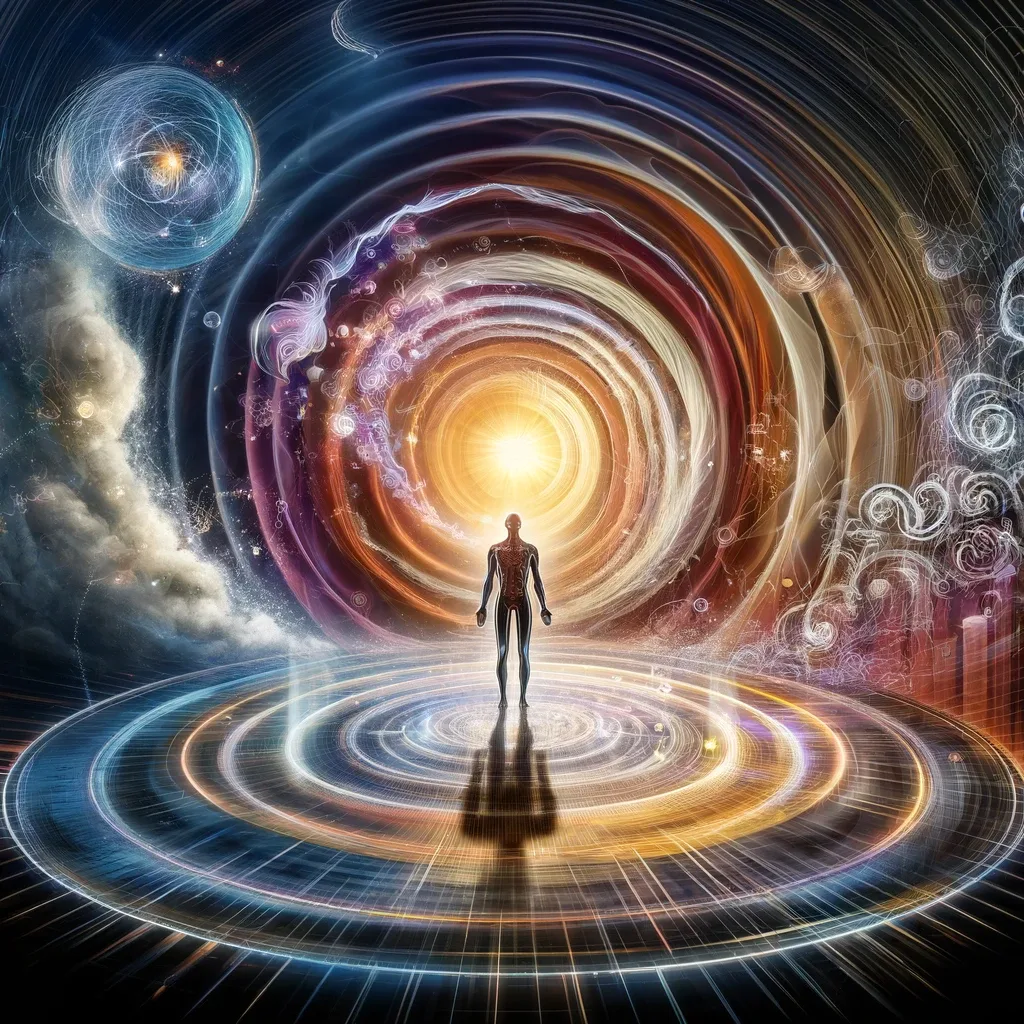
A solitary figure stands at the edge of a radiant vortex that draws the eye to its luminous center. The vortex is made of swirling bands of light in vivid colors, a tunnel with depth and motion in it. Around it are intricate cosmic patterns, stars, nebulae, and abstract digital designs, so that the line between the physical and the digital blurs. In the foreground, concentric circles of light spread out from the figure’s feet, adding to the sense of movement and energy. The figure itself is in shadow, with faint highlights along its outline, as if on its way into something unknown. The whole scene carries wonder, exploration, and the merging of human consciousness with the vast universe.
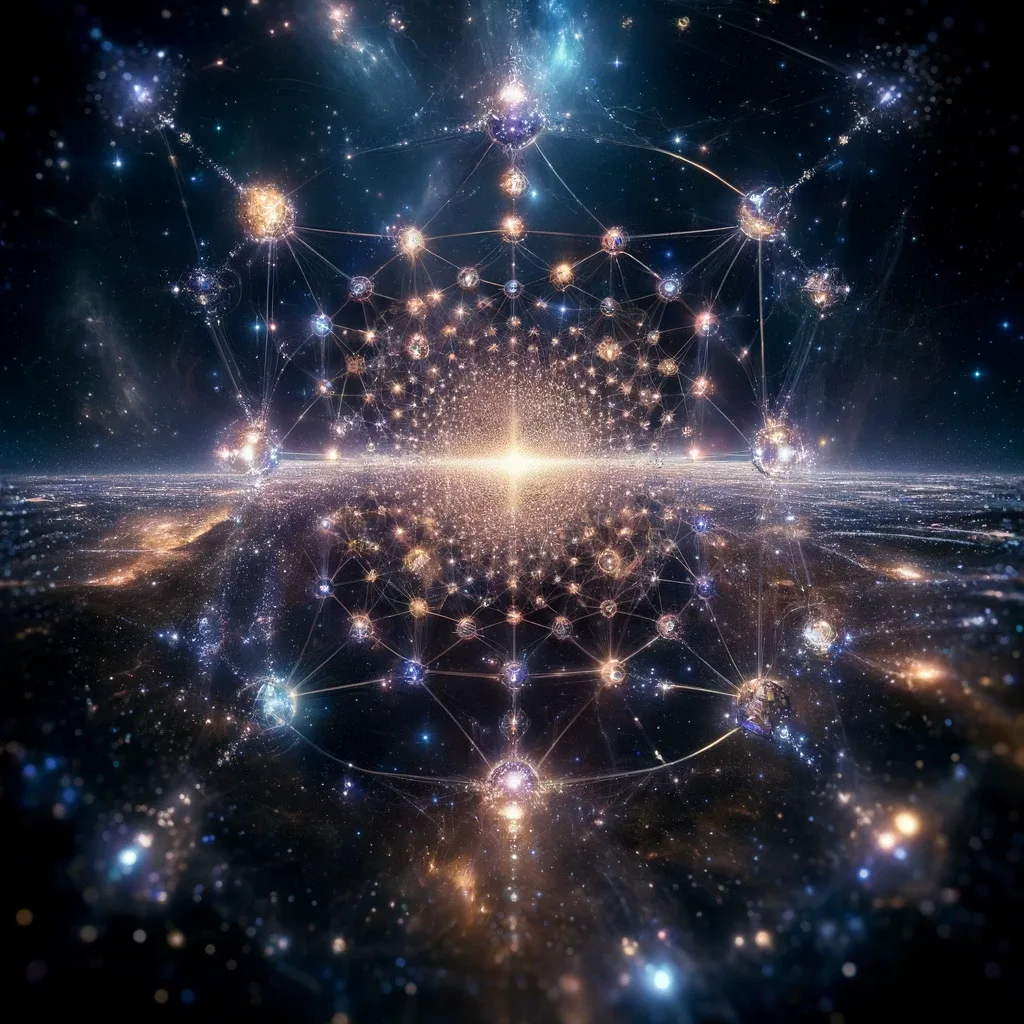
Cosmic Web of Light
An intricate network of glowing nodes joined by luminous lines, a web spread through the vastness of space. At the center one radiant point shines brightest, surrounded by countless smaller nodes. Behind it is a deep expanse of stars, galaxies, and cosmic dust, with no end to its depth. The joined nodes and lines suggest a vast cosmic network: the interconnectedness of the universe, or a future’s data and communication networks on a cosmic scale. The scene is ethereal, scientific imagery with something of the mystical in it.

An ancient temple, finely detailed in its architecture, stands serene against towering mountains covered in mist. Warm golden light falls on the temple and gives it a feeling of quiet reverence. Above it a large glowing sphere gives off ethereal light, with flowing, wave-like patterns extending from it, digital harmony blending into the natural world. The sphere holds mysterious symbols, one more layer of mystery. In the foreground, flowing lines like a digital network or data streams join the traditional with the modern, a fusion of ancient wisdom and futuristic technology. The whole is serene and futuristic at once, timeless tranquility and interconnectedness.
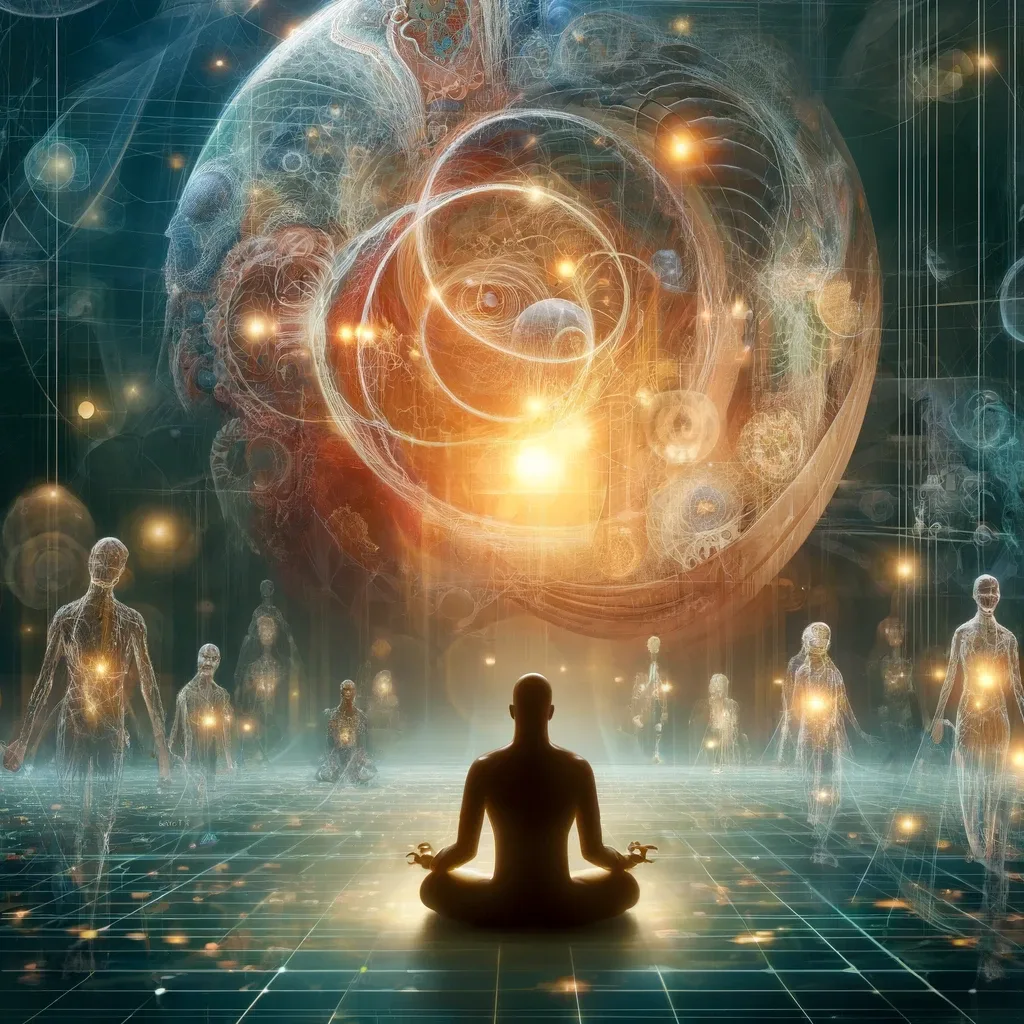
A central figure sits in meditation on a grid-like surface that suggests a digital environment. Above the figure is a vast luminous orb giving off warm, radiant light and intricate swirling patterns, a focal point of cosmic energy. Around the central figure are ethereal, translucent beings, each glowing softly, as if sharing one state of meditation or consciousness. The background is complex abstract design and celestial elements, blended for depth and mystery. The scene carries a strong sense of spiritual connection, the metaphysical and the digital together, the meeting of inner peace and the vast interconnectedness of the universe.
First published on temnoon.com. Re-voiced from that original, in the Tem Noon Voice persona (9497f2d0) on 2026-10-11; the original is kept in the archive.